

Custom orthotics that actually fix the problem
Real relief for foot pain. Built for how your foot actually moves.
Generic insoles cushion the pain. A custom orthotic corrects what's causing it — so you can get back on your feet and stay there.
Every step puts pressure on your foot — an orthotic moves it
When too much pressure lands on one spot repeatedly, that tissue can't recover. Pain starts. An orthotic doesn't remove the pressure — it redistributes it, giving the sore spot a rest so your body can heal.
Based on the Tissue Stress Theory — the clinical framework used by podiatrists worldwide.
How much pressure is too much?
Three things an orthotic does
Moves pressure off the sore spot
Adds support where needed, leaves space where it hurts — so load shifts away from injured tissue.
Corrects how your foot rolls
Guides the inward roll to a healthy range — less rolling, less strain on your arch, tendon, and ankle.
Gives one specific spot a break
Pads, lifts, and carved spaces offload one precise location. Everything else keeps working normally.
GoMFO in three steps — nothing else required
You identify the condition. Your patient does the rest from their phone. We handle everything else.

Get the prescription
Doctor selects the condition and sends the patient a link. That's the only step required from the provider.

Patient scans at home
Our AI-guided photo tool captures foot measurements on any smartphone. No clinic visit, no equipment, no appointment.
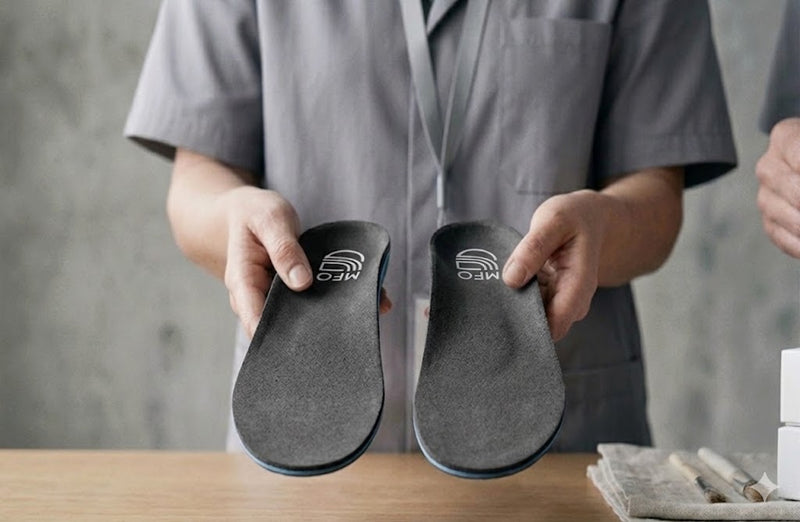
It ships to the door
Handcrafted to the patient's measurements, reviewed by a clinician, shipped direct. $129. 120-day free returns.
Different pain, different fix
Select a condition to learn what's happening in your foot and exactly how an orthotic helps.
Custom fit changes everything
A store-bought insole gives every foot the same shape. That's why it helps a little but doesn't fix the problem. Here's the difference.
Real doctors who spent their careers on this
Foot orthotics are not guesswork. They're based on years of research by doctors who studied exactly how feet work, how they get hurt, and how the right kind of support helps them heal.






Full clinical rationale, prescribing protocol, and how to get prescription pads for your practice.
For DoctorsA custom foot orthotic is a special insert that fits inside your shoe. It's made to match your foot exactly — not a standard shape, but one based on a scan or mold of your actual foot.
Think of it like a brace that helps your foot sit in a better position. It's thin enough to fit in your everyday shoes, and most people stop noticing it's even there after a few days.
A store-bought insole is made to fit everyone — which means it doesn't really fit anyone perfectly. It might add some cushioning, but it doesn't change where pressure goes in your foot, because it was never shaped for your foot in the first place.
A custom orthotic is shaped from your actual foot and built with specific features for your specific problem. That's what allows it to actually move pressure away from the sore spot.
Most people notice a difference within the first 2 to 4 weeks of wearing the orthotics every day. Some problems like heel pain or ball-of-foot pain can feel better even faster, because less pressure is hitting that spot right from your very first step.
But here's something important: less pressure doesn't instantly heal the tissue. It just gives your body the time and space it needs to heal. Full recovery usually takes 6 to 12 weeks, depending on how long you've had the problem and how bad it is.
It depends on what's wrong. If you have something like heel pain and your foot is otherwise healthy, you might only need the orthotic while you're recovering. After that, the right stretches and shoes can keep things feeling good on their own.
But if your foot has a structural issue — like flat feet or a very stiff big toe — the orthotic is more of an ongoing support tool. The shape of your foot isn't going to change by itself, so the orthotic keeps helping long-term.
Yes — as long as your shoes have enough room inside. Running shoes, work boots, and sneakers all work well. Your clinician will ask which shoes you wear most so they can build the orthotic to fit.
Remember: the orthotic only works when it's inside the shoe. Very flat or shallow shoes can be tricky — worth mentioning at your appointment so we can plan for it.
A well-made custom orthotic usually lasts 2 to 5 years. If you're very active, they'll wear out faster than if you use them more casually.
The soft top layer usually needs replacing before the hard base underneath — that's a quick fix. The base can also be adjusted without starting all over again.
Yes — orthotics work best as part of a bigger plan. Depending on your problem, your clinician might also suggest stretching (especially your calf muscles for heel pain), strengthening exercises for the small muscles in your foot and hip, and better shoes. Even the best orthotic won't work as well in a bad shoe.
It starts with some questions — how long the pain has been there, what makes it better or worse, what shoes you wear, and how active you are. Then the clinician will look at your foot while you're sitting and standing, checking your arch and joint movement.
After that, they'll watch you walk. This shows where the pressure is going and which spot is getting too much. From all of this, they'll know exactly what your orthotic needs to do. Most people leave with a clear answer about what's causing the pain and a solid plan to fix it.
Don't just live with the pain.
When the sore part of your foot stops taking too much pressure, it gets a chance to heal. That's what a custom orthotic made specifically for your foot and your condition makes possible.